Etiquetas

Mostrando entradas con la etiqueta English. Mostrar todas las entradas

viernes, 9 de septiembre de 2011

Lithuania, 2nd part: Bicycle trip across the country, and Rainbow Gathering.


From 10th of August and for about twenty days was the celebration of the Baltic Rainbow Gathering in a forest near Anyksciai, some 160 kms. from Kaunas. The Rainbow Gatherings are temporary egalitarian communities that have been held worldwide since the 70's, in contact with nature, and exposing the ideals of peace, love, nonviolence, respect for the environment and freedom as a counterculture opposed to consumerism and mass media. Basically, a bunch of hippies meeting! Indre (now my host) and I had never attended one, so we decided it would be cool to join the brothers for a few days.
The idea was to hitchhike, which would take about three hours. But it was too easy, so with a smile I asked, "What if we go by bike?". So I borrowed Tuchkus' bike, Hercules, who would become my partner in this first trip on two wheels of my life. Hercules was about 30 years, and the truth is that he had better times. Only two of the three shifts worked, the brakes were not working well and the seat (a beautiful vintage 80's Brooks, must be said...) was wobbly. But he proved his name right carrying over 40 kilos of luggage (mine and Indre) among clothes, sleeping bags, tents, food and kitchen utensils. Didn't do it to be a gentleman, but for practical reasons (as I like to pedal faster, decided it was a good idea to carry all the weight to make our pace even). Moreover, it was the perfect argument in case of discussion: "Don't you see I'm carrying all on my own?!". It did not to stop her from being behind me, so I had to tease her to pedal harder... The first day we left Kaunas in the afternoon (about 1pm) and took small regional roads, unpaved but with almost no traffic, going through small towns and villages in the countryside, with the kind of views and scenery that only in this kind of forgotten roads and going by bicycle can you find. We stopped for lunch in Jonava, where for 2€ I ate a generous portion of fish with melted cheese and baked potatoes, and kept going. We soon realized that going by bike was the best choice, with a beautiful landscape that looked like out of a fairy tale and beautiful wooded trails to ourselves. Here's a little video on the landscapes of Lithuania to give you an idea:


The sun began to fall on the horizon when we decided to stop to eat and camp near Ukmerge in some plantations behind the trees, off the road and  hidden from curious eyes. We had covered 80 kms. in half a day, not bad for the first time. Early the next morning we packed the stuff and prepared to start the day. But there was a problem: the unaccustomed bottom of Indre refused to continue. It was enough for him 6 hours cycling the day before on the umcomfortable sporty saddle her bicycle had, now she was paying the consequences. We tried to put a towel as cushion to minimize the martyrdom, and we managed to continue slowly. After noon we stopped to rest in a small village on the road called Kavarskas. We enjoyed a good cold beer (in the country is normal to drink at room temperature. Yakkk...) and smoked a cigarette (nothing better after exercise, kids!) on the green grass and under the warm sun of late August.


We passed Anyksciai and found a beautiful lake of fresh blue waters inviting us to swim. Indre wanted to stop, but I had enough of stopping and stopping here and there, and all I wanted to do was to reach the final destination before the night and leave all the crap I was carrying. So in spite of Indre's dissapointment we kept cycling, and in a small town called Andrioniskis, close to the meeting, we stopped to ask directions. The lady was super friendly and knew about the Rainbow, so it was pretty easy to find the place.

We traversed Lasiniai and Inkunai on small roads through the forest until we finally met Urtas, who showed us the path. We saluted some of the guys that were there and went looking for a place to drop things and pitch the tent. Then, socializing a bit, the usual presentations and a good swim in the crystaline waters of the river passing by. We met all the people, who were already there for two weeks, drank some tea and they told us a little about the meeting. I also met Airida and Gabriela, whom I met at the ecofestival, of which Gabriela was also an organizer. When night fell, we ate under the stars and around the campfire the delicious traditional dish of Uzbekistan (Plov) that Sergei had prepared. Before eating, we all standed in a circle around the fire holding hands, and began to sing songs and praises giving thanks. I ate three huge plates, with my stomach open for both days of cycling, and we were drinking tea and chatting until midnight, when I decided to go to my lovely tent to rest and recharge batteries.


Woke up early next morning and had a tea with Urtas' brother and Katja. She was German and had been for a few years traveling the world. That day was Saturday, main day of the biggest folk music festival of the country, so many people had left. I wanted to go, but it was too late and now it was difficult to get there on time, so we planned to spend the day in the woods. We helped Serguei to cook "borsch" and delicious mushrooms that they had brought the forest and had an amazing flavor of chicken and fish. We spent the night playing some guitar with a guy from Norway while Ehres played the didgeridoo, and talking about things.
But the forecast for the next day was heavy rain and thunderstorms after noon, so we decided that the most sensible option would be to wake up at dawn and get out as early as possible, and to pedal strong to have halfway done and be camped in good spot when eventually the storm came. So we woke up early and said goodbye to the kids. Ricardas, who had made many bike trips and sometimes fixed bikes in his spare time, gave me some advice and checked Hercules. We started, and after 15 kms. we stopped at Andrioniskis to buy supplies and eat something. From there, keep going and another stop in Kavarskas, where Hercules and me faced a pretty decent climb. Standing on the pedals, trying to keep balance with the excessive baggage, and zigzagging from edge to edge of the road to minimize the slope. It wasn't much, but given my condition of beginner looking back from the top while trying to recover my breath I felt like the first man to climb Mount Everest. I decided I deserved a good cold beer (Svyturios, Lithuania's most popular) to celebrate, and stop with Indre for a bit. I started trying to provoke her gently to make her go faster, and the strategy worked: a little angry and frowned began to pedal as crazy to prove she wasn't a weak woman. Finally! For a couple of hours we moved at over 30 km/h. I was trying to keep up the pace with all the load, tailgating wheel to wheel to cut the strong headwind, when she suddenly decided to brake in front of me. My brakes were not really working, so it wasn't perhaps the smartest choice, and I ended up smashed in the middle of the road. Luckily, no cars were coming at the time and I suffered no more inconvenient than a few scrapes on the knees... The good news was that at least it was not raining, and although the sky was overcast, it seemed unlikely that the feared storm was coming.


Past Jakutiskiai, Indre's batteries ran out and started again the pain in the buttocks, so we returned to the weary speed of 10 km/h. But we were not far from our destination and had covered a good chunk of the way so we could relax a little. A beautiful golden sun began to shine, illuminating the cotton puffy clouds and the green fields the men worked, as their parents and the parents of their parents did from ancient times, in their simple lives, devoted to the Mother Earth and the eternal circles of life.


In the small town of Bukonys we stopped to refill the water bottle and buy cigarettes and chocolates,  essential supplies on any good trip that deserves to be regarded as such. We asked a few locals that were spending the hours sitting on a bench and staring at life passing by for directions, and I laughed inside of their stupor when Indre told them where we came from. I think I could have told them we were from another planet and they wouldn't have been more astonished. So we ate some chocolates in a bench by a pond as rumors spread in the village and people passed looking at us.


We reached Jonava (25 km. from Kaunas) whit a couple of hours of sunshine left, but decided to cheat and take a train (at the end of the day we realized we would have done it faster by bike ...). 120 kms. in a day was fine and we could treat ourselves to rest on the station and sip a coffee. It was the end for now. But the seeds of the idea of ​​another adventure, this time much larger, were already planted in our minds ...

jueves, 8 de septiembre de 2011

Lithuania, 1st part: Ecofestival, and an adventurous week in Kaunas.

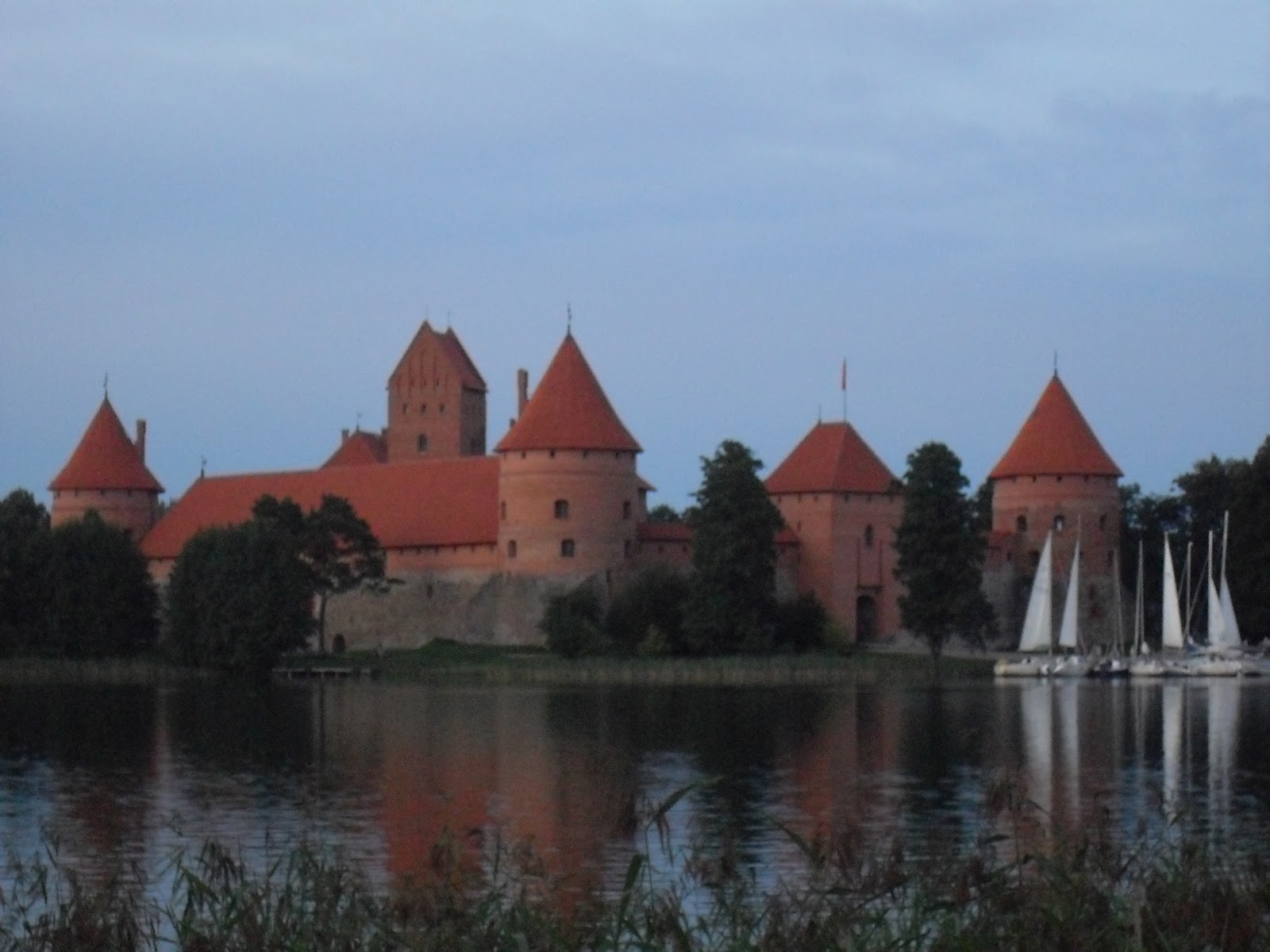
Trakai's Castle

We met Tuchkus, Paulius and Edvinas late in the dark night, and headed in the car straight to the festival. Some girls with angelic voices were singing Lithuanian folk music and people watched the show at the starlight. We put the tents, all baggage and went to check the field. While it was an eco-festival where no alcohol or meat was allowed, we went with Tuchki and the people to a far corner eating a salami washed down with a good bottle of wine. Always like the salmon, swimming against the current... The sky that day was special: it was going to be the largest meteor shower in few years, and although the sky was partially covered and we didn't stay until the proper time, we saw a good number of them performing their igneous dances through the skies.
We spent the weekend at the festival, meeting local people and learning a little of their culture. Paulius's (Ponulis, for friends) girlfriend, Vaida, organized the event. There was not many people (about 200), but it was the right people, all very cool. I learned some phrases in Lithuanian, to weave typical bracelets and belts in the traditional local style, went to workshops on various topics (although I didn't understand much since they were in Lithuanian), and learned to sing some 'sutartinės', one of the oldest and most outstanding examples of traditional music, considered Masterpiece of the Oral and Intangible Heritage of Humanity by UNESCO.
 

The great Tuchkus and Jovita

We passed Trakai's Castle, a beautiful construction from the early XV century and symbol of Lithuania, and went to Tuchkus' house in Kaunas, to try to organize a little some activities to do on the week. The next day we went all around Kaunas by bike, passed the Yacht Club and the beautiful Pazaislis, Lithuania's largest monastery and best example of Italian Baroque architecture in the country.


Later we met Giedrius for a bit of history in a place sacred to the ancient pagans, the confluence of the two largest rivers in Lithuania: Niemunas and Neris. Giedrius is the Kaunas' ambassador for the CouchSurfing website, and knows a lot of history and traditional legends, so it was very interesting for me to hear a bit of their world. From there we went to try some local beers with Knut from Germany and Gintare and her friend. The next day we meet again with Giedrius, Ponulis, Vaida, Knut and a couple of guys to go to the VI Fort of Kaunas, one of the many forts of the city (now abandoned), built in the late XIX century by the Russians to protect the western border of the Empire, and during World War II (with the invasion of Lithuania by Germany) served as a prison and death camp for 35,000 Jews and prisoners of war from the Red Army. The place was overgrown by nature and in ruins, and we had to walk amongst wild plants to enter the hidden places armed with flashlights to explore the broken fragments of forgotten stories beneath the sands of time. The rooms where the bodies were burned were still covered by a cloud of black ash that made breathing almost impossible.
 

Giedrius, great storyteller and CS City Ambassador

We ended up covered in soot and mud, and with those looks we went to a remarkable 'bar'. In Lithuania it is forbidden to sell alcohol after 10 pm, so what the ingenious local businessmen did was simply to put a table and two chairs inside and pretend to be a bar, and sell alcohol 24 hours to thirsty throats. This particular one was full of curious specimens of local wildlife that came to socialize and enjoy 50 cents pints of beer ('alus', in Lithuanian). So we were for some time enjoying the holy malt brew and chatting with the locals. Our looks should not have been the best because one of them, far from dressing elegant, asked: "So you are gypsies, eh?". Paroxysms of laughter.
Another day Tuchkus had the idea to go rowing on the Nemunas River. The boat in question was an inflatable one that had passed its best days and was patched on all sides. As you may imagine, we arrived late on the scene, we set the boat in the wrong way, so when we finally got into the water it was nine o'clock. So we started rowing. Well, James began to row. Because Tuchkus spent over an hour on the phone and I was wedged between the seats unable to move, so it was him who had to do the effort, sweating and mumbling swearwords a good part of the15 kms we had to cover. The current was extremely slow, so we had to rush over the last hour and paddle all the time because we had to meet Indre, Jovita and Thomas for a few beers.


We also did a dinner with friends for some 15 people in Tuchkus' house that week. I prepared a few litres of delicious Sangria and James cooked and incredible double baked pork belly with chimichurri sauce and God knows what else, maybe the tastiest food I've ever tasted. He finished his Chef studies and apprenticeship in New Zealand, and now wants to travel around Europe (especially Italy) to learn more about the different culinary traditions. And I, of course, was delighted to be his companion... 


We organized that weekend an event on the small local group of CouchSurfing. The idea was to get together in Tuchkus' parents' summer house, playing guitar around the campfire and perhaps a dip in the river at night. We arrived with James after cycling 15 kms. between wooded dirt roads and small towns. The place and the house were beautiful, and soon came Indre, her younger sister Julija and two CouchSurfers, Dave from Australia and Andre from Brazil. Then Tuchki came, and later Ponulis, Vaida, Giedrius and Dovile (Tuchki's girlfriend) completed the cast. The warm beer, snacks and music flowed, and the rain did not stop a good time. Late at night Ponulis, Vaida and Giedrius returned to the city and we stayed overnight. The next day we woke up and ate something, watched a good movie, Andre returned to the city and the other guys decided to go shopping and picking mushrooms in the forest despite the rain. I'm not a friend of bad weather, so decided to stay at home taking a nap under a beautiful blanket and the heat of the fire. Indre's later tonsillitis proved that mine was the best choice. Later James, with the help of the boys, cooked a really good pasta with mushrooms and white wine sauce that we quickly devoured. We spent another night together in the house, and the next day we returned to Kaunas.
As Tuchkus parents were staying in his apartment, me and James decided to stay with Indre and Julija, with Dave and cats Panda and Salomas as great company. We played the 'chancho' (a classic Argentinian card game. Very simple, but a good excuse for drinking and having fun). Julija was the first to lose, and as punishment we throwed 20 liters of cold water and over 2 kgs of flour, which took her like an hour to take off her hair. James was next to lose, and he had to drink a fair amount of '999 '(a green herb liqueur typical of Lithuania) and run naked around the block ...
The next day was James' last day in Lithuania, and now he had to hitchhike about 2000 kms in three days to be on time at the farm in northern Italy where he was going to spend some time doing wwoofing volunteering. So we parted ways with some sadness after all the miles and the stories together, but with the certainty of seeing each other again soon down on the road ...

miércoles, 7 de septiembre de 2011

From Krakow to Lithuania. Last day hitching with James through the beautiful polish countryside, and the expected reencounter with Tuchkus.


Once again it was time to go: three days in the same place was too much! So we woke up as the sun rose over the roofs of Krakow, filled the bag with our meager belongings and left. We walked for an hour in the cool of the morning until we got to the service station we chose on the road and out of town. Other 'Spanish breakfast', some questions to sour-faced employees and start the day!
The path we had chosen for the day was 600 kms. traversing Poland and its capital Warsaw to the border with Lithuania, and then another 100 kms. to Kaunas and the expected encounter with Tuchkus, with whom we had lived and traveled in Malaysia and Australia. In fact, with him I spent the most remarkable new year's eve of my life. We were both in Sydney (probably the best place on earth to see the new year's celebrations) and alone, almost without knowing anyone and without a dime... What to do? I had an unorthodox idea: make a big sign that between pretty drawings said something like: "New Year's Eve! Help us with a coin, a beer, a job or a nice girl!". And we began to ask everyone that we passed by, with a big smile and telling something of our history. People were surprised by our strange marketing strategy: someone finally asking honestly for money to get really drunk! And so, in just over an hour, we got like $50 ... sooo, bought a five-liter cask of the cheapest wine (goon!), and in a disinterested display of alcoholic generosity donated the rest to a charity (I must admit that we repented it when the wine ran out ...). Then we met Min Woo, a South Korean friend, and 15 minutes before midnight jumped the fences escaping the police to the place where more than half a million people were looking forward to the celebrations and beginning of the new year.
Poland is probably my favorite country for hitchhiking. The people are friendly and very used to hitchhiking. Until the early '90s this was an official mean of transport, organized by the National Tourism Board. Each hitchhiker had a ID card with assurance included, and the drivers could get points and prizes. It was therefore quite easy to find a lift to Warsaw. After some 15 minutes, Aneta offered to drive us the 300 kms. that separated us from the capital. She lived in England but had started a business in Krakow and was traveling with two guys who worked with her. She was very nice and good conversationalist, and we crossed half Poland hearing of her adventures, travels, family and future plans.


We stopped at a small gas station after Warsaw, in good position to continue north, as many cars were going in our direction. He had just received a message from Tuchkus. Last minute plan change: instead of going to Kaunas, we should meet with him and his friends in an ecofestival in the middle of nowhere. As we had no money to call him and he is famous for its comic disorganization, almost four hours passed until we finally had a little idea of ​​where we had to go. At the gas station waited like 15 minutes until Michał took us another 30 kms. until another gas station after Wyszkow. 

 
Next to the narrow road, girls in tight clothes offered their services to tired drivers looking for imitations of love. We ate a small snack beside the road, and after another 20 minutes Florian took us towards Białystok. He was German but lived and worked as a lawyer in Poland, from where his wife was. He was a funny man (yes, there are good lawyers!), with crazy stories of restless youth and interesting points of view. He veered a few miles out of his way to leave us in good position, and we parted ways on the side of the pictoresque wooded road. 


We were there for a while, because again we had a long-distance sign with the majority of cars being locals. Finally, and after about an hour, some guys offered to take us through some typical small countryside towns to a gas station halfway towards Augustow. 


After another half an hour Marek and Gabriela gave us another short but helpful lift. We talked about life and this and that crossing green fields, and I had a chance to practice my 'Polengruski' (my poor Polish mixed with some English words and sounding like the Russian I learned some years ago). They left us at a gas station outside that city, only 50 kms. to the border with Lithuania. 


There, a short wait and another lovely couple offered to drive us 200 kms. until near Trakai, a few miles from the festival. We crossed the border as the night began to lay a cloak of dark velvet over the picturesque fields of the southernmost part of the Baltic country, talking about past memories, stories of a restless present and colourful future plans. It was late when we parted ways wishing each other a happy life, on the road intersection where we were supposed to be meeting Tuchki and friends. 


The night was dark, lit only by the dim silver light of stars, and with a dense fog covering the fields. The minutes passed, and we were not sure if we were in the right place because there was no road signs and the roads themselves did not resemble the map so much. We started walking without knowing where we were going, until some time after a car hit the brakes in front of us. Tuchkuuus! We hugged jumping in the middle of the road, and we told each other all our latest adventures as we went to the festival with their friends. But that's part of another story ...

domingo, 4 de septiembre de 2011

Krakow: a bit of history and breaking some myths. Also, Auschwitz and its horrors.


 I felt very happy to be back in Poland, with its grandmother food in big portions, cheap beer, beautiful women and nice people. We arrived with Dominik in Bielsko Biala as the sun fell on the horizon and decided to cheat and take a bus to spend the night in Krakow. I called Martha, but she was still in Warsaw, returning from a trip around Portugal and having some problems in their  car, so meeting that night was unlikely and finally got a room at the hostel of a friend of her. Arrived at the bus station and the first thing we did was eating a 'zapiekanka', traditional Polish snack consisting of a half open baguette with cheese, mushrooms and a little sauce. We were hungry after a long day and the zapiekanka tasted deliciously like one euro... From there, to the hostel, a well-deserved shower and recover energies.The next day we left our backpacks at the hostel and went to visit the city. We found a free walking tour, in the style of others 'free walking tours' of other European cities. These tours take you through some 3 hours around the city and work on donation bases or tips. They are usually very fun and a great option to get an idea of ​​the history and customs of the place, and meet other backpackers, as opposed to pay tours (which are full of retirees with hat, shorts, Hawaiian shirts, sandals and socks and photo camera) because they gather mostly young people short of cash and travelers hungry for experiences. Unfortunately the guide was not too funny, but also learned a lot about the city and the country, places and history. One legend attributes the founding of the city the mythical ruler Krakus, who built it above a cave occupied by a ravenous dragon. Many knights unsuccessfully attempted to oust the dragon fighting him until a shoemaker named Dratewka gave the dragon a sheep full of sulfur, which he ate, then drank the water from the Vistula River and exploded. The center of town (Stare Miasto) is beautiful, with examples of Renaissance architecture, Baroque and Gothic, and was declared a World Heritage Site by Unesco in 1978.


The city dates from about s. X, when it was starting to be considered an important trading center. Was almost completely destroyed during the Tatar invasions from the s.XIII and then rebuilted, flourishing with the Lithuanian-Polish union between s. XIV and XVI. The city survived intact the atrocities of World War II as it was considered by Nazis as a German city. The most representative buildings and sites are now the Castle and Cathedral on Wawel hill, numerous churches and museums scattered throughout the center, the huge market square (200 m side), the district of Kazimierz (the old town of the Jews of Poland) and Saint Mary's Cathedral.


  From the top of this, a trumpeter plays every hour a famous melody (Hejnal Mariacki) culminating in a broken note. It is a symbol of the city, and according to legend was the trumpeter who playing the same tune constantly alerted the entire population of the coming Tatar invasion and therefore saved the city. Unfortunately, a Tartar arrow pierced the throat of the hero, so the song is played unfinished in his honor. The song is played by the Polish national radio every day at noon, and would be a beautiful and poetic story ... if it wasn't a dirty lie. The legend was forged in the 1920s by an American tourist of the various legends he heard from the locals and later captured in a famous book, "The Trumpeter of Krakow," Newbery Award winner in 1929.
Wawel Hill is also beautiful, with its Royal Castle and Cathedral. The cathedral is considered the Polish national shrine, having been through its thousand-year history coronation site of numerous Polish monarchs. Sigismund Chapel, with its gold dome and his masterful Tuscan Renaissance style of the XVI century, is considered one of the brightest examples of architecture from Poland, and many kings and queens are buried beneath the frescoes and sculptures in its splendid interior.


n the afternoon we met with Marta, which whom I had done a nice trip around Europe a few years ago, and we amused ourselves chatting about this and that and trying traditional food. As she could not host us because his mother was in unexpected visit, we wrote a message in the last minute group on CouchSurfing. After 10 minutes received a call from Jacek offering a couch and a few minutes later an email from Egil for the same reason ... So we met Marta and Jacek later and walked through the city to the picturesque district of Kazimierz, the Jewish community center from the s.XIV to the Second World War, now a UNESCO World Heritage and artists' neighborhood, with the best bars in town.


We made a strategic stop in the Singer and Alchemia bars. The first is a beautiful wooden bar lit with candles, beautiful paintings and takes its name from the old sewing machines that serve as tables. We went early, but according to legend after eleven people begin to dance. There's no place, you say? Above the tables then, of course!. The Alchemia is another beautiful bar of those  which are not forgotten. With its decadent wooden interiors, furniture and paintings, and an eternal cloud of smoke highlighting its evocative atmosphere, all lit in the dim candlelight. The entrance to some rooms is done through a small closet, and it feels like time travel to the 20s. From there, cross the street to Plac Nowy (New Square), which serves the best zapiekankas Krakow. We walked to the center, drank a little more, and went to the home of Jacek, to watch some funny videos and talk about anything just before bedtime.


The next day I decided to try another free tour of the city, the Jewish Tour, around the points of the Hebrew history of the city. The guide was much better this time and it was very interesting to find some half-buried history under the sands of time. The Jewish community in Poland before the war was the largest in Europe (3.5 million, or 33% of total) and only in Krakow Jews numbered a quarter of the total population. We passed the old synagogue (the oldest in Poland and the city museum) and Remuh and Izaac synagogues (one active and the largest of Krakow respectively).We passed the place where they filmed one of the most important scenes of the movie "Schindler's List" and cross the river to the Ghetto. Before War II, Krakow's Jewish population was 68,000. With the advent of the Nazis deported most of the city, and 15,000 other 'able to work' were herded into the ghetto again in subhuman conditions. Finally, the ghetto was liquidated between June '42 and March '43. The population fit for work were sent to camps Belzec and Plaszow, the Auschwitz death camps or simply killed in the same streets. From there we went to the 'factory' of Schindler. Or the museum and the office where the inevitable souvenirs are sold. Schindler's figure is highly controversial, and almost everything you see in the film is fake. Rather, it was the American writer Thomas Keneally who invented the figure in the book "Schindler's Ark". The Jews were rather used as slave labor in their factories, and he was not the author of the famous list, but an officer of the SS. To get into the list they had to have some contact or family in the secret services and, according to testimony of survivors, pay the exorbitant sum of $ 5,000. Alas, another nice myth shattered by the cruel reality ...The next day was our last day in town and decided to go with James to Auschwitz.About 40 kms. Krakow was the largest extermination center in the history of Nazism, which is estimated to have been killed between 1.5 and 2.5 million people. The entrance to Auschwitz I grimly held the famous inscription "Arbecht Macht Frei" (Work makes you free).


The facts, details and crowded conditions of the place are too long and horrible to detail here, and gave me goosebumps. Just thinking of the levels that collective madness can achieve and that this had happened only 70 years ago. I had read "Man's Search for Meaning" by Viktor Frankl, fantastic book which details his experiences as a prisoner in concentration camps from the perspective of its psy
chiatric effects. One of my favorite books, and I was overwhelmed by a feeling of pain walking through the places described in it and thinking about all the life stories prematurely shattered by the brutal stupidity of men